
Price Action
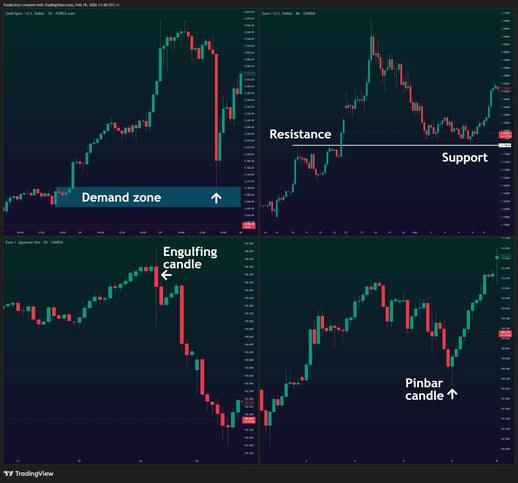 Learn how to read price movement with clarity and turn chart observations into repeatable decisions.
This hub organizes our best price action guides, from key levels and trend reading to breakouts, pullbacks, and execution. Use it to build a clean, practical approach you can apply across markets and timeframes.
On this page:
 What is price action?
Core price action guides
Candlestick pattern guides
Common price action setups
Free price action mini course
Price action FAQ
 Price action is the practice of reading a chart by focusing on how price behaves: how it trends, pauses, accelerates, and reacts at important areas.
You learn to spot meaningful moves, recognize when a market is pausing or breaking out, and understand where buyers or sellers are likely to defend key areas. From there, you build a simple plan: what needs to happen before you enter, where your idea becomes invalid, and what a realistic target looks like.
The biggest advantage of price action is that it keeps you focused on execution. It helps you avoid overthinking, trade with clearer rules, and evaluate setups in a consistent way.
Supply and demand trading
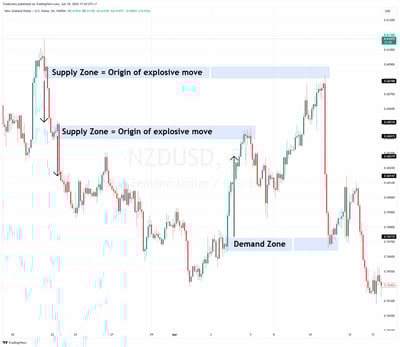 Spotting supply and demand zones on your charts can be a helpful trading tool. Similar to support and resistance levels, these zones highlight areas on the chart where the price is likely to bounce or reverse. Traders use these zones to pinpoint areas where they might buy or sell. In other words, supply and demand zones act as a first filter, helping you identify potentially profitable price levels...
Trendline trading
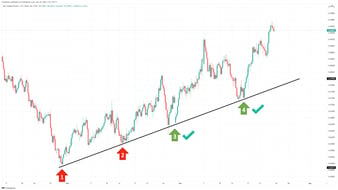 By drawing trendlines on price charts, you can identify long-term trends and potentially profit from them. This guide will walk you through everything you need to know about trendline trading, from the basics of drawing trendlines to using them to enter and exit trades. Along the way, we'll also explore some common pitfalls to avoid and how to...
Support and resistance
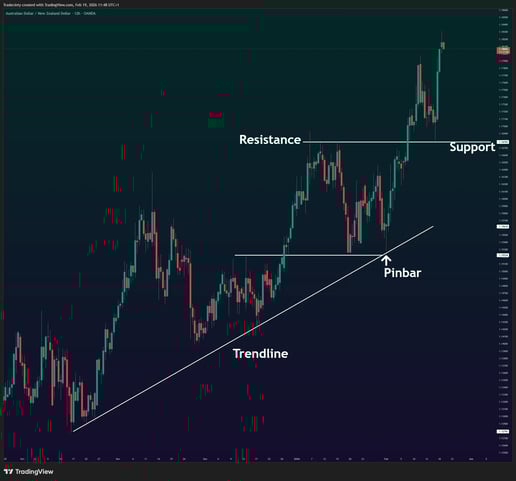
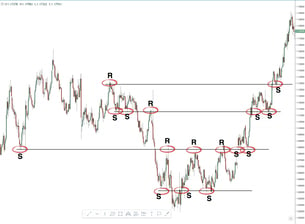 Support and resistance trading is very powerful and knowing how to draw support and resistance levels on your price charts is a key skill for any trader. However, we often see that traders make many mistakes when it comes to finding the best levels. In this article, we help you understand how to find the best support and resistance levels...
Breakout trading
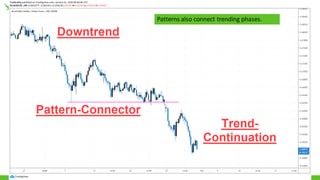 Breakouts are the triggers of new trends and theconnectors between different trends. And that’s really, really important to understand between a downtrend as we’ve seen here. And an uptrend, usually you will see a range market and the range markets can have many different forms as we will see during the phase of this video...
5 pullback strategies
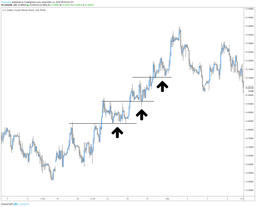 Learning how to trade pullbacks can be a great skill as a trader. Pullbacks happen all the time and if you learn how to trade pullbacks, you can enhance your repertoire and find many more high probability trading scenarios. Pullbacks come in many different forms and in this article, I explain the five most common ones. You will also learn different pullback entry techniques...
Engulfing candlestick pattern
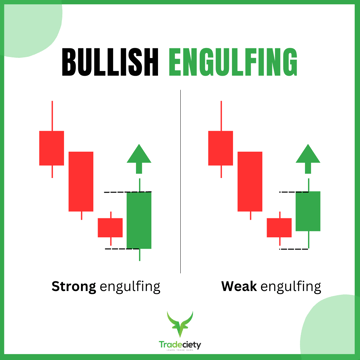
An engulfing candlestick pattern is a powerful signal of momentum reversal in technical analysis, and identifying one is quite simple. This pattern occurs when the body of the current candlestick fully engulfs the body of the previous one, signaling a potential shift in market sentiment. In a bullish engulfing pattern (BE+), the price action forms a large bullish candle where both the high is higher, and...
Evening star candlestick
.png?width=180&height=180&name=Long%20Wick%20(1).png) The Evening Star pattern is a powerful bearish reversal pattern that signals a potential change in market direction from an uptrend to a downtrend. This classic candlestick formation is widely used by traders to predict trend reversals, especially after a sustained price rally on a higher timeframe...
The Evening Star pattern is a powerful bearish reversal pattern that signals a potential change in market direction from an uptrend to a downtrend. This classic candlestick formation is widely used by traders to predict trend reversals, especially after a sustained price rally on a higher timeframe...
Pinbar candlestick
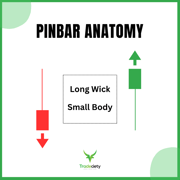 One of the most powerful and frequently observed patterns is the pinbar candlestick. In this guide, we'll dive into what a pinbar candlestick is, how to identify it, and, most importantly, how to trade it effectively. To fully understand the power of the pinbar, it’s essential to dissect its structure. A typical pinbar has three main components:
10 most profitable candlesticks
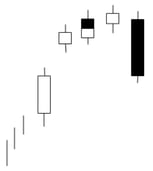 There are roughly ten that have statistically significant levels of accuracy–from 84% to 57%. We also give credit to the research that Thomas Bulkowski has done in this field and from whom we derive much of what we’re about to present. So let’s get to it–the 10 top-performing profitable candlestick signals...
The Inside bar candlestick
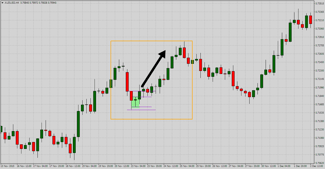 Inside bars are among the most popular candlestick patterns price action traders use in their analysis and trading. Defined as (usually) a smaller ranged bar that is totally engulfed by the bar prior to it – these are great to identify halts in momentum that can serve as a crucial cue when looking for trade setups...
8 price action secrets
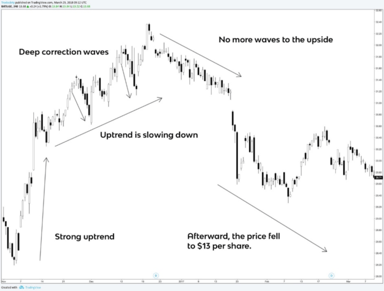 Price action is among the most popular trading concepts. A trader who knows how to use price action the right way can often improve his performance and his way of looking at charts significantly. However, there are still a lot of misunderstandings and half-truths circulating that confuse traders and set them up for failure. In this article, we explore the 8 most important price action secrets and share the best price action trading tips...
Master candlestick patterns
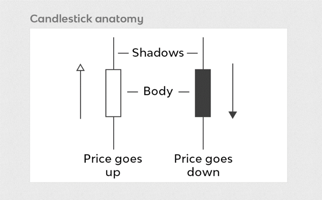 Candlestick charts are further developed line charts – which the image below shows – that serve to compensate for the disadvantage of less information. Candlestick charts have their origin in 17thcentury Japan. Today, candlestick charts are the preferred tool of analysis for traders and most investors since they provide all the required information at a glance. In this article, you will learn everything you need to master candlesticks patterns like a true professional...
8 candlestick strategies
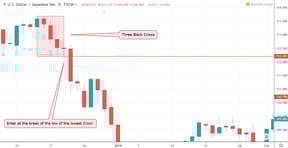 Since Japanese rice traders developed the Candlestick by incorporating open, high, low and closing prices, traders have identified a number of patterns that offer high probability trading opportunities. Candlestick patterns come in different sizes and shapes. There are single period candlestick patterns like the pin bars, but also, you can find patterns that involve more than two bars, like the Three White Soldiers. However, not all patterns offer the best win rate in Forex. We have identified eight major candlestick patterns that actually work in Forex...
5 tips for reading price action
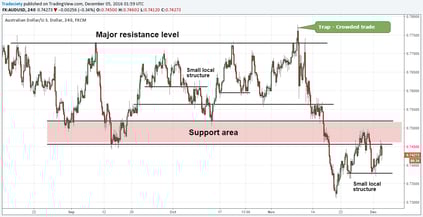 Being able to read a price action chart is important to make the right decisions. The problem many traders have is that they overcomplicate things and get easily confused – or they don’t have a process in the first place and don’t know what they are looking for. In this article, I want to explain 5 different concepts of price and technical analysis that will help you make sense of charts and understand the price dynamics in a more effective way...
Exhaustion and rejection
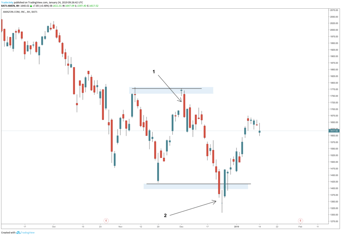 I just love trading transition points where a Forex pair goes from uptrend to downtrend or from downtrend to uptrend. Those transition points are super hard to trade and very very challenging, but, at the same time, once you understand how to read them, you can take your trading to the next level and understand almost any price chart. Two very important principles in this trading context are “exhaustion” and “rejection” and those price action concepts can...
If you want a structured introduction to price action, start with our free Price Action Trading Course on YouTube.
In about an hour, you’ll learn how to read charts with clarity. From candlestick behavior and price patterns, to trend analysis and practical trade execution.
It’s a practical walkthrough you can apply across markets and timeframes.
In this course you’ll learn:
How to read candlesticks and use comment candle triggers.
How to identify trends and understand market structure.
How to spot breakouts and pullbacks.
How to combine price action into simple strategies.
.png?width=64&height=64&name=icons8-trading-64%20(1).png)
Price Action
Read price clearly with candlesticks, key levels, and practical entry triggers.
Top guides: Supply and demand trading · Trendline trading guide

Chart Patterns
Learn continuation and reversal patterns, breakout rules, and how to spot fakeouts early.
Top guides: Cup and Handle · Triangle pattern guide

Market Structure
Understand trends and ranges using swing structure, breaks, and regime shifts.
Top guides: Elliot wave analysis

Trading Indicators
Use indicators such as moving averages, RSI, volatility tools, and simple filters.
Top guides: Moving Averages · Bollinger Bands

Risk Management
Build consistent risk rules with position sizing, stop placement, and reward-to-risk planning.
Top guides: Reward to risk ratio · Position sizing
.png?width=64&height=64&name=icons8-mind-64%20(1).png)
Trading Psychology
Improve execution by fixing common mistakes, managing emotions, and building discipline.
Top guides: Why 95% of traders fail

Trading Strategies
Explore proven strategy types—breakouts, pullbacks, trend following, and mean reversion.
Top guides: 3 trendline strategies · Day trading strategies

Trading Process & Improvement
Develop consistency with journaling, reviews, metrics, and a repeatable trading routine.
Top guides: Best trading journal · Backtesting guide