
Market Structure
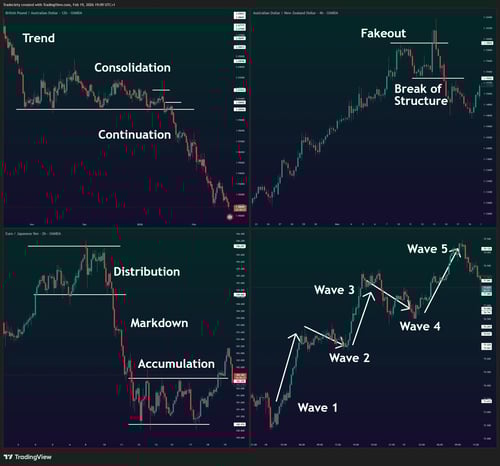 Learn how to read market structure and understand what price is doing right now: trending, ranging, or transitioning.
This hub breaks market structure down into simple, practical concepts like swing highs and lows, trend progression, range behavior, and structure breaks.
Use it to build clearer scenarios, avoid choppy conditions, and trade with a stronger directional plan.
On this page:
 What is market structure?
Core market structure guides
More market structure guides
4 clues for reading market structure
Market structure FAQ
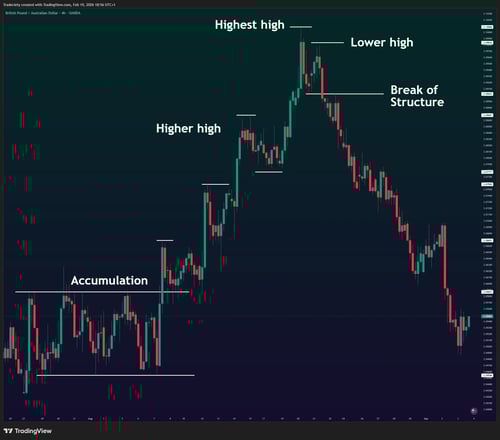 Market structure describes how price moves over time by forming swings that reveal direction and behavior. By studying that swing sequence, traders can tell whether a market is trending, ranging, or transitioning into a new phase.
In simple terms, market structure is the “map” that helps you understand where price has been, where it is likely to react, and what would signal a meaningful shift.
The purpose of market structure is clarity. Instead of reacting to every candle, you focus on the swings that matter and the points where the market changes its character. When you understand market structure, it becomes easier to build scenarios, avoid choppy conditions, and align your setups with the current phase of the market.
Elliot Wave Theory
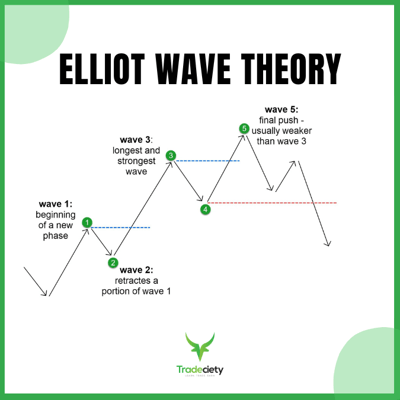 Elliot Wave Theory (EWT) is a popular method of technical analysis that helps traders predict market trends by analyzing the psychology of market participants. Developed in the 1930s, this theory suggests that market prices follow specific patterns driven by collective investor behavior, known as waves. Understanding these waves allows traders to forecast...
Wyckoff trend analysis
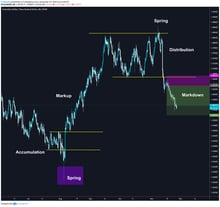 Many traders have heard about the Wyckoff method and the Wyckoff trend analysis. In this article, we help you understand the different Wyckoff concepts and we share tips on how to include the Wyckoff analysis in your trading. At the core of the Wyckoff method are the different trend and market phases which...
How to find trends
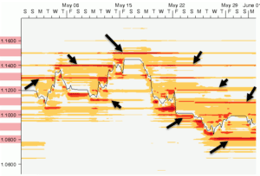 Whether you are a price action, a pattern, an indicator or whatever trader, if you are able to identify strong price levels on your charts, it can greatly improve the quality of your trading. Instead of taking signals and trades all over the place, the better trades...
How to trade consolidations
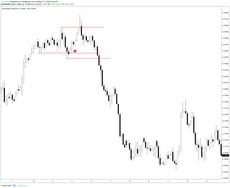 Consolidations happen either during trending market phases or before a new trend. There are different consolidation patterns as we will see later: sideways ranges, wedges, double/triple tops or triangle shaped consolidations, just to name a few. All consolidations represent a period...
7 tools for trend-following trading
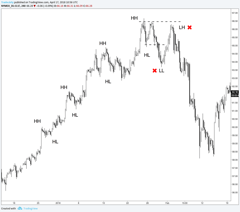 Trading with the trend is trading with the flow. When the prevailing trend is up, why would you want to look for short entries when buying might result in much smoother trades? Many amateur traders, even when facing a very obvious trend can’t stop trying to predict reversals and burn their fingers going counter-trend...
Multi timeframe analysis
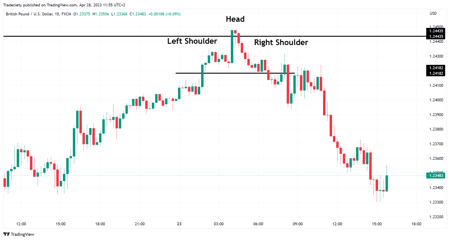
Multi-timeframe trading describes a trading approach where the trader combines different trading timeframes to improve decision-making and optimize their chart analyses. The goal of multi-timeframe trading is to enhance the profit profile of individual trades by trading long-term signals in a short-term timeframe. We´ll explain what this means with concrete examples ...
Understanding reversals
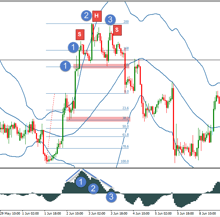 In the following article we explore how to use confluence analysis to detect price targets, how to stay in trades longer and how to identify possible reversals. For this purpose, we use Bollinger Bands, Fibonacci extensions, the MACD histogram and price action patterns to form well-rounded trade ideas...
Trading linecharts
 Sometimes in my trading career, I have been lost among the trees. My charts were so cluttered I could not make one clear decision, yet produce one valid trade idea that I liked. Everything was gibberish, paralysis through analysis. Whenever I got a signal in one direction, other things I learned and watched gave me a signal into the other direction...
Heiken Ashi candles
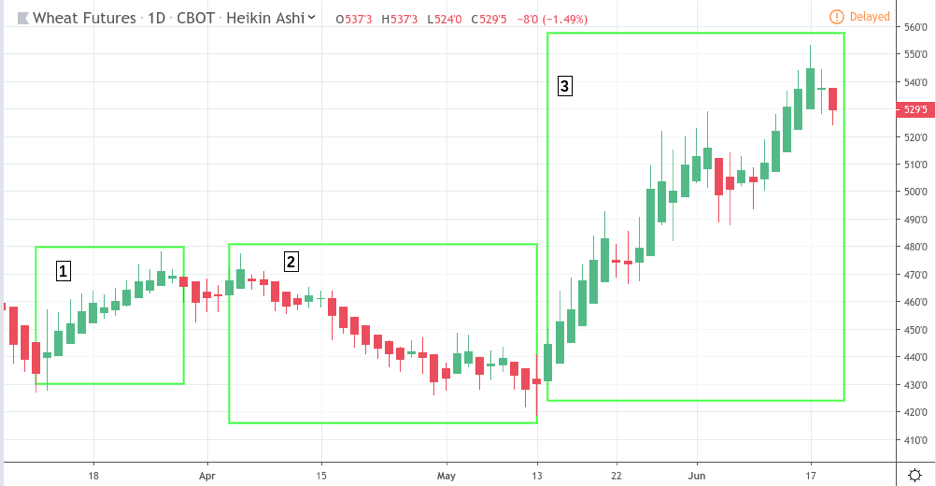 When using heikin ashi, you can treat it the same way as you would a traditional candlestick chart. The difference is that prices have been smoothed-out to reflect directional bias. As with candlesticks, you might use chart patterns with a heikin ashi, but your view...
Technical analysis tips
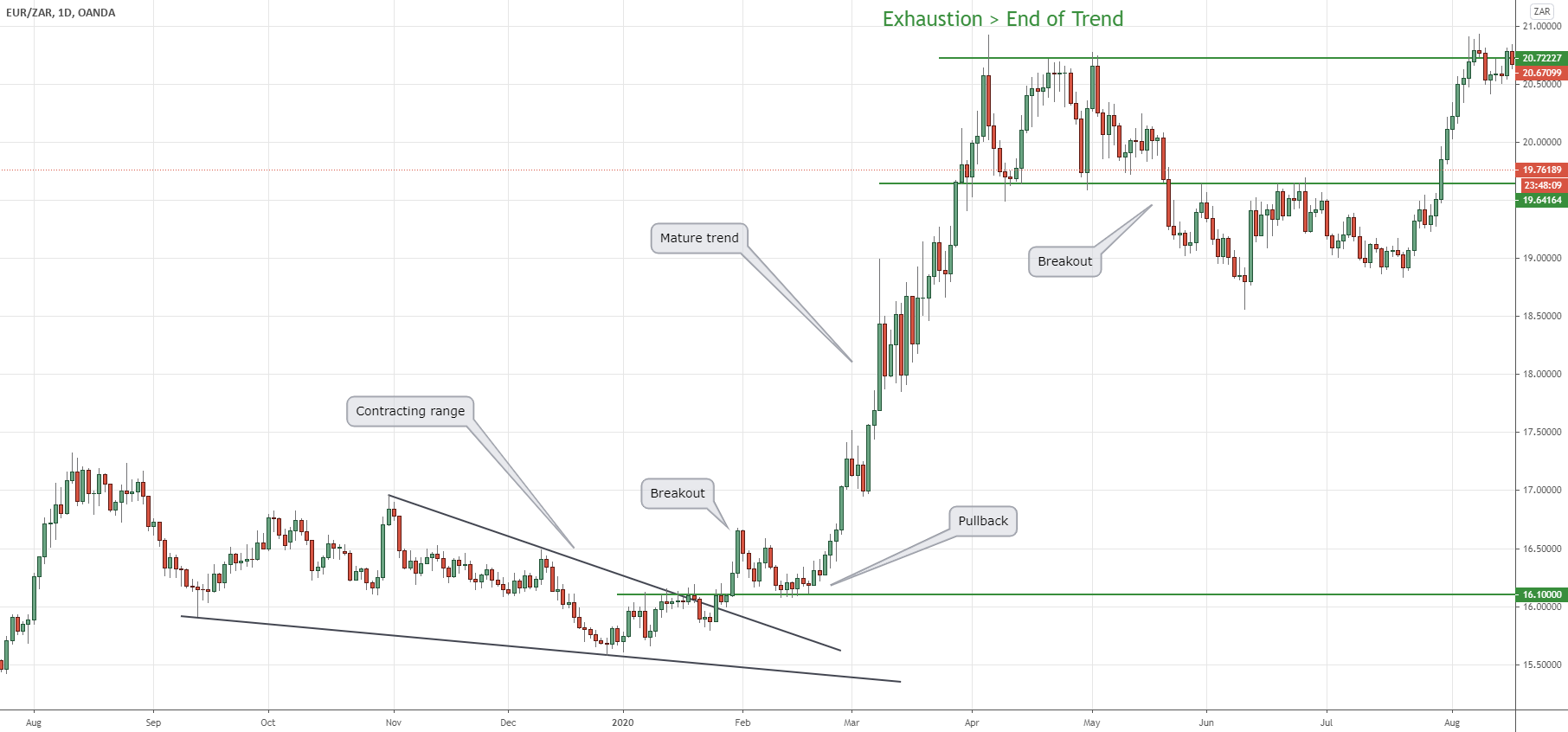 Most beginner traders look at a chart and use the combination of technical analysis tools to make trading decisions based on a single dimension, often on a single timeframe, without paying attention to the big picture. As a result, when broader trends change or the market enter a consolidation...
If you want a structured introduction to price action, start with our free Price Action Trading Course on YouTube.
In about an hour, you’ll learn how to read charts with clarity. From candlestick behavior and price patterns, to trend analysis and practical trade execution.
It’s a practical walkthrough you can apply across markets and timeframes.
In this course you’ll learn:
How to read candlesticks and use comment candle triggers.
How to identify trends and understand market structure.
How to spot breakouts and pullbacks.
How to combine price action into simple strategies.
.png?width=64&height=64&name=icons8-trading-64%20(1).png)
Price Action
Read price clearly with candlesticks, key levels, and practical entry triggers.
Top guides: Supply and demand trading · Trendline trading guide

Chart Patterns
Learn continuation and reversal patterns, breakout rules, and how to spot fakeouts early.
Top guides: Cup and Handle · Triangle pattern guide

Market Structure
Understand trends and ranges using swing structure, breaks, and regime shifts.
Top guides: Elliot wave analysis

Trading Indicators
Use indicators such as moving averages, RSI, volatility tools, and simple filters.
Top guides: Moving Averages · Bollinger Bands

Risk Management
Build consistent risk rules with position sizing, stop placement, and reward-to-risk planning.
Top guides: Reward to risk ratio · Position sizing
.png?width=64&height=64&name=icons8-mind-64%20(1).png)
Trading Psychology
Improve execution by fixing common mistakes, managing emotions, and building discipline.
Top guides: Why 95% of traders fail

Trading Strategies
Explore proven strategy types—breakouts, pullbacks, trend following, and mean reversion.
Top guides: 3 trendline strategies · Day trading strategies

Trading Process & Improvement
Develop consistency with journaling, reviews, metrics, and a repeatable trading routine.
Top guides: Best trading journal · Backtesting guide